UE/R: SOCO PROJECT FACILITATORS URGED TO WORK HARD FOR THE SUCCESS OF THE PROJECT – DCE NABDAM
By Prosper Adaakai
Enrolment at Nawognia Prima you School in the Navrongo Municipality of the Upper East Region has increased from seven pupils at its inception to 47, following the provision of a new classroom block, but school authorities are appealing for inclusion in the Ghana School Feeding Programme to sustain and further boost enrolment.
The Headmistress of the school, Lucy Ati, says the introduction of the school in the community has provided an opportunity for children who previously had to travel to neighbouring communities to access basic education.
Speaking during a visit to the school by GBC News, Madam Ati recounted the difficult conditions under which teaching and learning initially took place, describing the school’s former learning environment as inadequate and disruptive.
According to her, when she was posted to the school, classes were conducted under an open pavilion, exposing pupils and teachers to harsh weather conditions, interruptions from passers-by and other environmental challenges.
She said whenever it rained, teaching had to be suspended, with pupils sometimes seeking shelter in nearby homes while teachers secured their furniture and other learning materials. The Headmistress also disclosed that teachers had to clean the pavilion before classes could begin, as the facility was occasionally littered with animal droppings and urine.
She added that the open space also attracted individuals whose activities occasionally disrupted lessons. Madam Ati said the challenges notwithstanding, the school began with seven pupils and has since recorded an enrolment of 47, reflecting growing interest in education within the community.
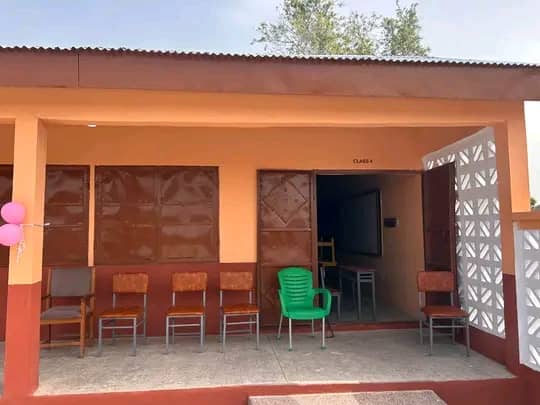
The school has since moved into a newly completed classroom block, which has provided a more conducive environment for teaching and learning. The facility has classrooms equipped with ceiling fans, electricity, furniture, chalkboards and marker boards, among other amenities.
The school is currently running Kindergarten One and Two, as well as Basic One, Two and Three, while gradually building its foundational classes.
Madam Ati expressed gratitude to the government for the facility, noting that the improved infrastructure would help strengthen teaching and learning and encourage more children to attend school.
However, she said the school continued to face challenges attracting pupils from neighbouring communities, particularly where access to school feeding services remained a major consideration for parents.
The Headmistress appealed to the government to extend the Ghana School Feeding Programme to Nawognia Primary School, arguing that access to meals could significantly improve enrolment and attendance.
She observed that some children continued to attend neighbouring schools partly because those institutions benefited from the feeding programme.
“ We hope that you bring the school feeding programme because it is the feeding that will increase the number of pupils,” she appealed, urging authorities to prioritise the school’s inclusion in the programme.
She believes the provision of meals would not only attract more pupils but also help retain children in school and improve participation in learning.
The Assembly Member for the Wuru-Nagantuna Electoral Area, David Atubuga, said the community had struggled for years to secure a functional primary school, describing the new classroom block as a significant development for residents.
He explained that efforts to establish a school in the community date back several years, with an earlier infrastructure project initiated in 2016 but not fully operational at the time Mr. Atubuga said he later worked with education authorities and community members to mobilise children from the area and neighbouring settlements to begin schooling at the facility.
He commended the government for completing and furnishing the classroom block and pledged the community’s support towards maintaining the facility to ensure it serves its intended purpose. According to him, community leaders and residents have a responsibility to safeguard the infrastructure and ensure that the school remains in good condition for future generations.
He expressed hope that the development would encourage more children to enrol and provide the community with improved educational opportunities. Community seeks additional development support Beyond education,
Mr. Atubuga appealed for further development interventions, including a health facility to address the healthcare needs of residents.
He said the absence of a nearby clinic or health facility could pose difficulties, particularly in emergencies involving children and other vulnerable residents.
The community also hopes for additional infrastructure and development support to complement the new school and improve living conditions.
The growth in enrolment from seven to 47 pupils highlights the potential of community-based educational infrastructure to expand access to basic education, while the call for inclusion in the Ghana School Feeding Programme underscores the importance of complementary interventions in sustaining that progress.
Source – gbcuraonline.com