UE/R: SOCO PROJECT FACILITATORS URGED TO WORK HARD FOR THE SUCCESS OF THE PROJECT – DCE NABDAM
By – Urban Activist
There are moments when an award becomes more than a trophy.
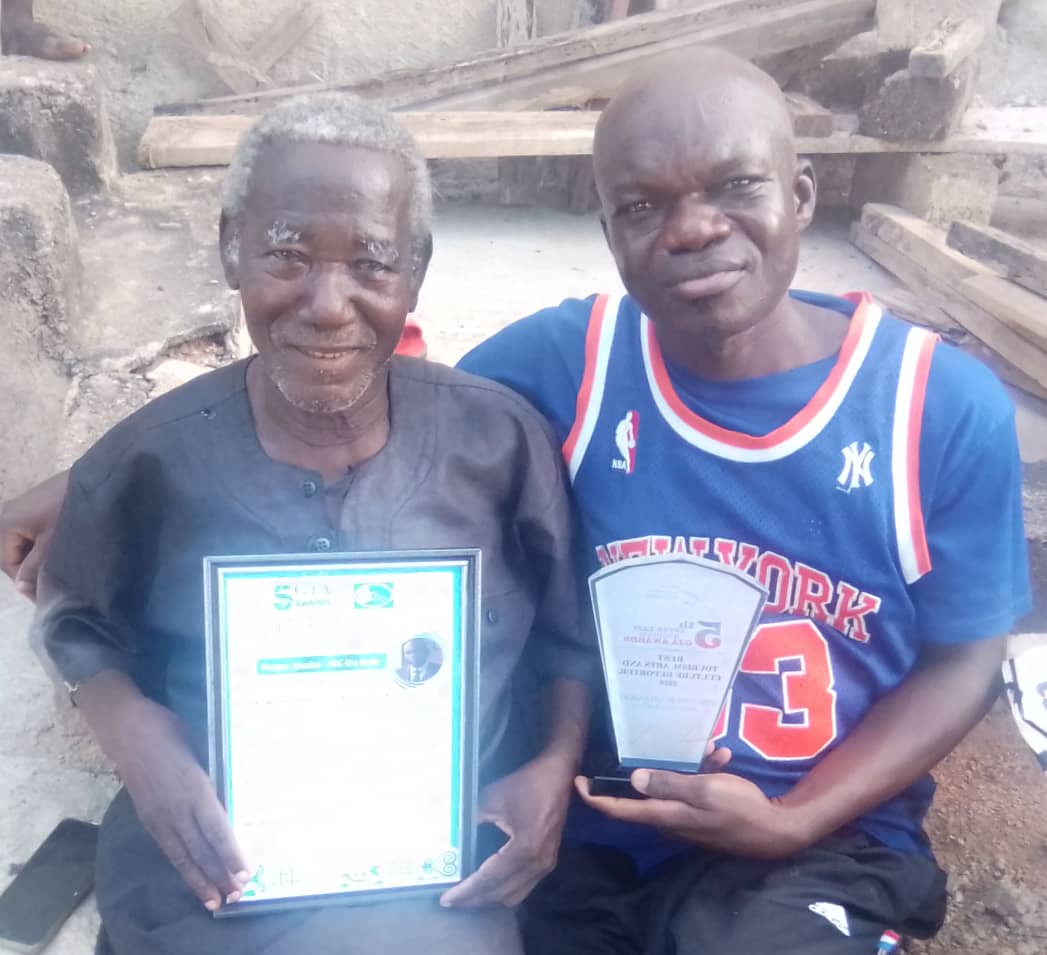
For journalist Prosper Adankai of GBC URA Radio, being named Best Reporter in Tourism, Arts and Culture at the 5th Upper East Regional Ghana Journalists Association (GJA) Awards was already a significant professional milestone.
But the achievement has gained another layer of meaning following a congratulatory message from one of the Upper East Region’s respected historians and writers, Christopher Anabila Azaare.
Azaare’s recognition of Adankai is significant not only because of his standing as a writer and historian, but also because his own life’s work has been devoted to documenting the history, traditions, cultural institutions and environmental practices that shape the identity of communities in northern Ghana.
In celebrating the journalist, the historian appears to be acknowledging something deeper: the power of storytelling to preserve a people’s memory.
A journalist telling the stories behind the headlines
In contemporary journalism, the pressure to chase breaking news can sometimes leave little room for stories about heritage, traditional knowledge, cultural practices and the people quietly preserving them.
Yet for communities such as those in the Upper East Region, these stories are an essential part of understanding who they are.
From traditional leadership and indigenous governance to festivals, crafts, architecture, music, oral histories and sacred spaces, the region possesses a cultural heritage that is both rich and diverse.
It is within this landscape that Prosper Adankai has built his journalism around stories that connect people with their communities.
His recognition at the GJA Awards, therefore, is not simply an acknowledgement of a reporter who covered tourism or cultural events. It is an affirmation of the importance of journalism that documents, interprets and gives visibility to heritage.
And when that work receives praise from a historian whose own scholarship centres on cultural preservation, the symbolism is hard to miss.
From Gowrie to the world of scholarship
Christopher Anabila Azaare’s own journey began in 1953 at Gowrie in the Bongo District of the Upper East Region.
His educational journey took him from Zuarungu Urban Council Middle Boarding School, where he studied between 1963 and 1967, to Navrongo Secondary School, which he attended from 1967 to 1972.
Between 1976 and 1979, he studied at the Meteorological Training School in Legon, Accra.
But his professional journey would eventually extend far beyond technical training.
In 1980, Azaare joined the Ghana Association of Writers, signalling a growing commitment to literature and the documentation of knowledge.
From 1988 to December 1995, he worked with the ICOUR/UNDP Agro-Forestry Project, combining his technical experience with an interest in sustainable land-use practices.
Over the years, his work has developed into a valuable contribution to the understanding of Ghanaian history, traditional institutions, culture and environmental practices.
Preserving traditional knowledge
Among Azaare’s notable publications is Tindaanaship and Tindaamas in Traditional Gurensi (Frafra) Communities: Land Use and Practices, published by the International African Institute in Cambridge in 2020.
The work examines traditional systems of authority, land use and indigenous practices within Gurensi communities.
It is the kind of scholarship that ensures that knowledge embedded in communities is not lost simply because it was passed down orally or existed outside conventional academic institutions.
Azaare has also contributed to broader historical scholarship.
His work on British colonial rule in Ghana between 1900 and 1956 appeared in Politics of Africa Anticolonial Archive, published by Rowman & Littlefield in 2017.
His 2015 publication on Sacred Trees in Ghana, in the Cold Mountain Review of Appalachian State University, further reflects his interest in the intersection between culture, history and the environment.
His body of work demonstrates that preserving heritage is not merely about looking backwards.
It is about ensuring that future generations understand the foundations upon which their communities were built.
The storyteller and the historian
This is perhaps where Azaare’s commendation of Adankai becomes particularly meaningful.
The historian preserves through research and writing.
The journalist preserves through reporting and storytelling.
One may spend years documenting traditional institutions, while the other may spend hours travelling to communities, interviewing residents, recording voices and translating experiences into stories for radio audiences.
Yet both are engaged in the same larger enterprise: making sure important stories are not forgotten.
For a journalist working in radio, this responsibility carries its own unique power.
A voice heard on air can reach a farmer in a remote community, a student in Bolgatanga, a policymaker in Accra or a member of the Ghanaian diaspora thousands of kilometres away.
A well-told story about a cultural site can generate curiosity.
A feature on a traditional craft can create appreciation.
An interview with an elderly custodian of history can preserve memories that might otherwise disappear with the passing of a generation.
An award—and a responsibility
The GJA award has given Adankai professional recognition.
But Azaare’s congratulatory message also presents an opportunity to look beyond the applause.
Awards can be destinations, but they can also become starting points.
For journalists covering tourism, arts and culture, the challenge is to move beyond event coverage and explore the deeper questions.
Who are the custodians of our heritage?
What happens to traditional knowledge when its custodians are gone?
Which historic sites are being preserved—and which are disappearing?
How can communities benefit economically from their cultural assets?
How can young people become participants rather than spectators in the preservation of their heritage?
These are stories that require persistence, curiosity and sensitivity.
They require journalists to listen.
A shared commitment to memory
Christopher Azaare’s congratulations to Prosper Adankai therefore carries significance beyond one journalist and one award.
It brings together two generations of storytellers connected by a shared interest in the history and cultural identity of northern Ghana.
One has spent decades researching and documenting aspects of Ghana’s past.
The other continues to use contemporary journalism and broadcasting to tell stories about the people, places and heritage of the present.
Their paths are different, but the purpose is remarkably similar.
To ensure that the stories of a people are seen, heard, remembered and passed on.
For Prosper Adankai, the trophy from the 5th Upper East Regional GJA Awards may mark a moment of professional achievement.
But perhaps the more enduring prize is the encouragement to keep telling stories that matter.
Because long after the applause fades and the award ceremony becomes a memory, the stories remain.
And sometimes, as Christopher Azaare’s commendation reminds us, the storyteller also needs someone who understands the value of the story to say: keep telling it.