UE/R: SOCO PROJECT FACILITATORS URGED TO WORK HARD FOR THE SUCCESS OF THE PROJECT – DCE NABDAM
By Prosper Adankai
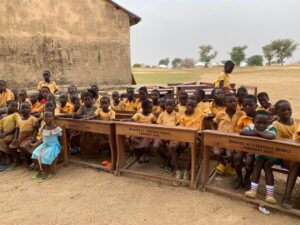
In Balungu-Ganlagrum, a small rural community in the Bongo District of the Upper East Region, philanthropy has taken a human face. What
arrived as ten dual desks may appear modest in number, but for pupils of the Balungu-Ganlagrum D/A Primary School, the donation represents compassion in action and a deliberate investment in the future of children too often left behind.
The Balungu-Ganlagrum D/A Primary School was established in 2016 through the collective effort of the community, driven by a shared belief that education is the most sustainable pathway out of poverty. Without external funding, parents and residents moulded mud blocks through communal labour to erect makeshift classrooms. Over time, those structures collapsed, leaving the school without permanent
infrastructure and deepening an already critical furniture deficit.
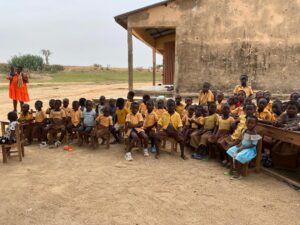
As a result, teaching and learning became an everyday struggle. Pupils sat on the bare ground, balanced exercise books on their laps, or
gathered under trees exposed to the harsh weather. Some children dropped out entirely, while others were forced to walk long distances
to neighbouring communities in search of better learning conditions, often at great personal risk.
Education experts agree that the foundation years of schooling are decisive. Children who learn in safe, well-resourced environments are
more likely to perform better academically, remain in school, and develop confidence and life skills. Yet for many rural schools like Balungu-Ganlagrum, the absence of basic infrastructure makes this vision difficult to realise.
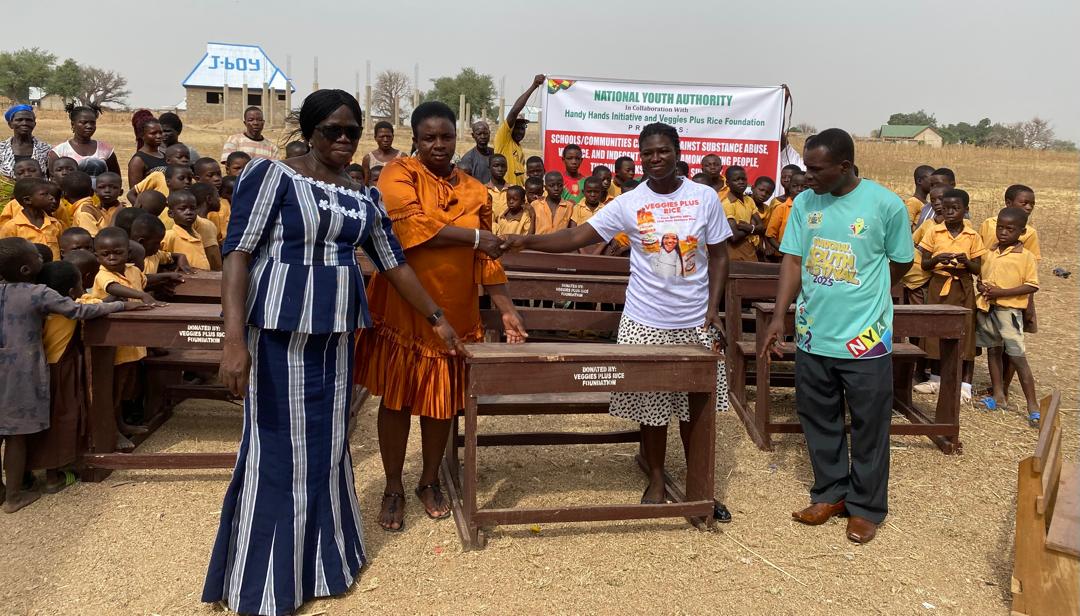
It was against this backdrop that Veggies Plus Rice Foundation, in partnership with Upper Hand Initiatives and the National Youth Authority (NYA), stepped in with a targeted philanthropic intervention. After profiling several deprived schools in the Bongo District, the partners selected Balungu-Ganlagrum D/A Primary School as a priority beneficiary, responding directly to the most urgent need—furniture for young learners. The donation of ten dual desks forms part of the Foundation’s corporate social responsibility, designed not as a one-off gesture, but as a strategic contribution to improving learning outcomes in underserved communities. For a school with a current enrolment of 81
pupils and a teaching staff of six, the desks provide immediate relief and restore a sense of dignity to the classroom experience.
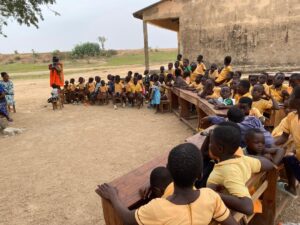
A visit by GBC URA Radio revealed the full extent of the school’s challenges. Kindergarten One and Two pupils, along with those in Basic
One to Three, were learning under trees due to the lack of classrooms. Basic Four pupils shared a single classroom, while Basic Five and Six classes were combined into one. Multigrade teaching, though sometimes effective when well-resourced, has become a survival strategy rather
than a pedagogical choice. Speaking during the presentation, the Headteacher, Madam Philomina Atinga Azumah, described the donation as timely and deeply impactful. She expressed heartfelt gratitude to Veggies Plus Rice Foundation, Upper Hand Initiatives, and the National Youth Authority for responding to the school’s needs when hope was fading.
She noted that one of the main reasons pupils continue to attend the school is its inclusion in the Ghana School Feeding Programme, which
provides daily meals and helps reduce dropout rates. However, she emphasised that nutrition must be complemented by a conducive learning
environment. She therefore appealed to government institutions, development partners, and philanthropic organisations to support the school with additional furniture and permanent classroom infrastructure.
Community leaders echoed this appeal. PTA Chairman Ben Ataweera Atinga used the occasion to call on the National Youth Authority to extend skills training programmes to young people in the area, arguing that empowered youth contribute directly to stronger families and better educational outcomes for children. The PTA Organiser, Abalungu Akan-melog, also highlighted the need for reading materials, stressing that access to books is essential for nurturing literacy and sustaining pupils’ interest in learning. For the National Youth Authority, the initiative demonstrates the power of collaboration. The Upper East Regional Director, Francis Takyi-Koranteng, commended Veggies Plus Rice Foundation for its commitment to grassroots development and for working closely with the Authority to identify a truly deserving school.
Representing Veggies Plus Rice Foundation, Madam Elizabeth Alenye, on behalf of Madam Helina, reaffirmed the Foundation’s dedication to
supporting vulnerable communities through practical, needs-based philanthropy. She expressed confidence that the desks would significantly enhance the learning environment and inspire pupils to stay in school and strive for excellence. In Balungu-Ganlagrum, philanthropy is no longer an abstract concept—it is something children can touch, sit on, and learn from. While ten dual desks cannot fix every challenge, they symbolise empathy, partnership, and the belief that every child, regardless of geography, deserves a fair start in life.
This intervention reminds us that meaningful philanthropy is not measured by scale alone, but by impact—by choosing to act where the need is greatest and where hope is waiting to be restored.