UE/R: SOCO PROJECT FACILITATORS URGED TO WORK HARD FOR THE SUCCESS OF THE PROJECT – DCE NABDAM
BY: ATUIMAH VALERIUS
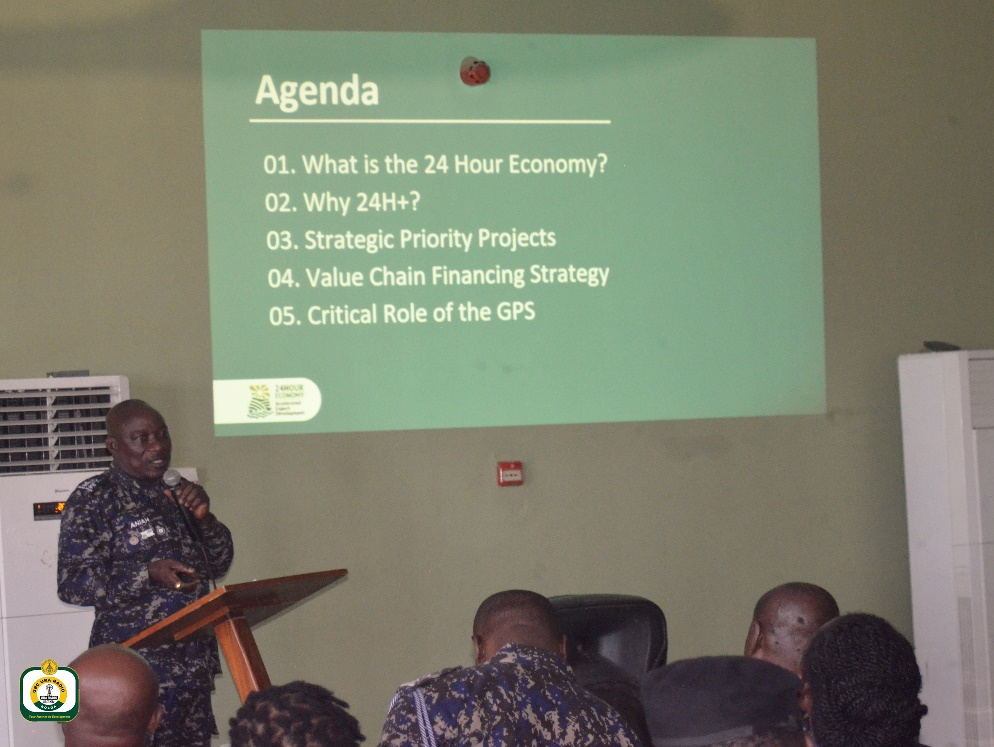
The Ghana Police Service (GPS) has held a major engagement with officers from all divisions in the Upper East Region to align them with the 24-hour economy policy, a flagship initiative of the Presidency. The event, held on Friday, August 29, 2025, at the Fountain Gate Auditorium in Bolgatanga, brought together key figures from police headquarters and the 24-hour economy secretariat at the Jubilee House.
The session focused on educating officers about the policy’s fundamentals and their crucial role in its successful implementation. Chief Superintendent Benjamin Aniah Esq., Director of the 24-hour Economy Secretariat, stated, “Part of our responsibility will be to let officers understand what the policy is about… and as they have a better acquisition of what the policy is, then we can zoom down to tell them what their role is in that policy.” He emphasized the interactive nature of the presentation, noting the active participation and thoughtful questions from officers, which demonstrated their appreciation for the policy’s concepts.
The Upper East Regional Police Command expressed their privilege at hosting the esteemed speakers, noting that they were “people with a lot of brains” who have taught the regional officers a great deal. The command underscored the vital nature of the policy. As well as reinforced the police’s critical function in the initiative’s rollout, declaring, “Police, as we are, we will be the front line. Police is the front line in the implementation of this context.”
The policy, which was a manifesto promise, aims to be a “propellant” and “catalyst” for industrialization, moving Ghana away from an import-dependent economy to an export-led one. According to the document, the initiative seeks to create 1.7 million new jobs, boost economic growth, and increase exports by leveraging a private sector-led approach. It prioritizes sectors such as agro-processing, manufacturing, pharmaceuticals, construction, and digital services. The government’s role will be to facilitate this transformation through incentives like tax breaks and exemptions on import duties for manufacturing equipment.
Chief Superintendent Dr. Sasu Mensah, speaking on behalf of the Inspector General of Police (IGP), highlighted the police’s integral role, emphasizing that the service will be at the “frontline” of the implementation. He detailed a deployment plan that outlines the responsibilities of officers and the need to enhance police-community relations to ensure a safe and secure environment for round-the-clock business operations. The Inspector General’s remarks underscored the honor of participating in the conversation and accepting the invitation from the police administration to engage with officers on this critical national policy.
A significant aspect of the discussion was the visual representation of the policy’s goals through its official logo. Chief Superintendent Aniah explained that the logo, featuring the map of Ghana, highlights three key economic zones. The “yellow” northern enclave symbolizes solar power, a clean energy source intended to power the 24-hour economy without overstretching the national grid, and the region’s vast, untapped gold and mineral reserves. The “green” middle belt represents the country’s rich forest belt, abundant in resources like gold, timber, and diamonds. Finally, the “blue” coastal area signifies the “blue economy,” which includes Ghana’s territorial waters and exclusive economic zone. The director noted that a recent study revealed that the hidden gold in the northern region alone far surpasses all gold extracted in the country to date.
The police officers were informed that their traditional role of providing security would be crucial to the program’s success. The presentation stressed the importance of collaboration with other security agencies, including the private security sector, to create a conducive environment for businesses to thrive at all hours. The discussion concluded with a commitment from the police leadership to support the policy and ensure that officers are well-prepared for their role in this national development effort. The police are expected to provide services within the context of the 24-hour economy and, as part of the Jubilee House’s initiative, have been authorized to present on their behalf and answer questions.