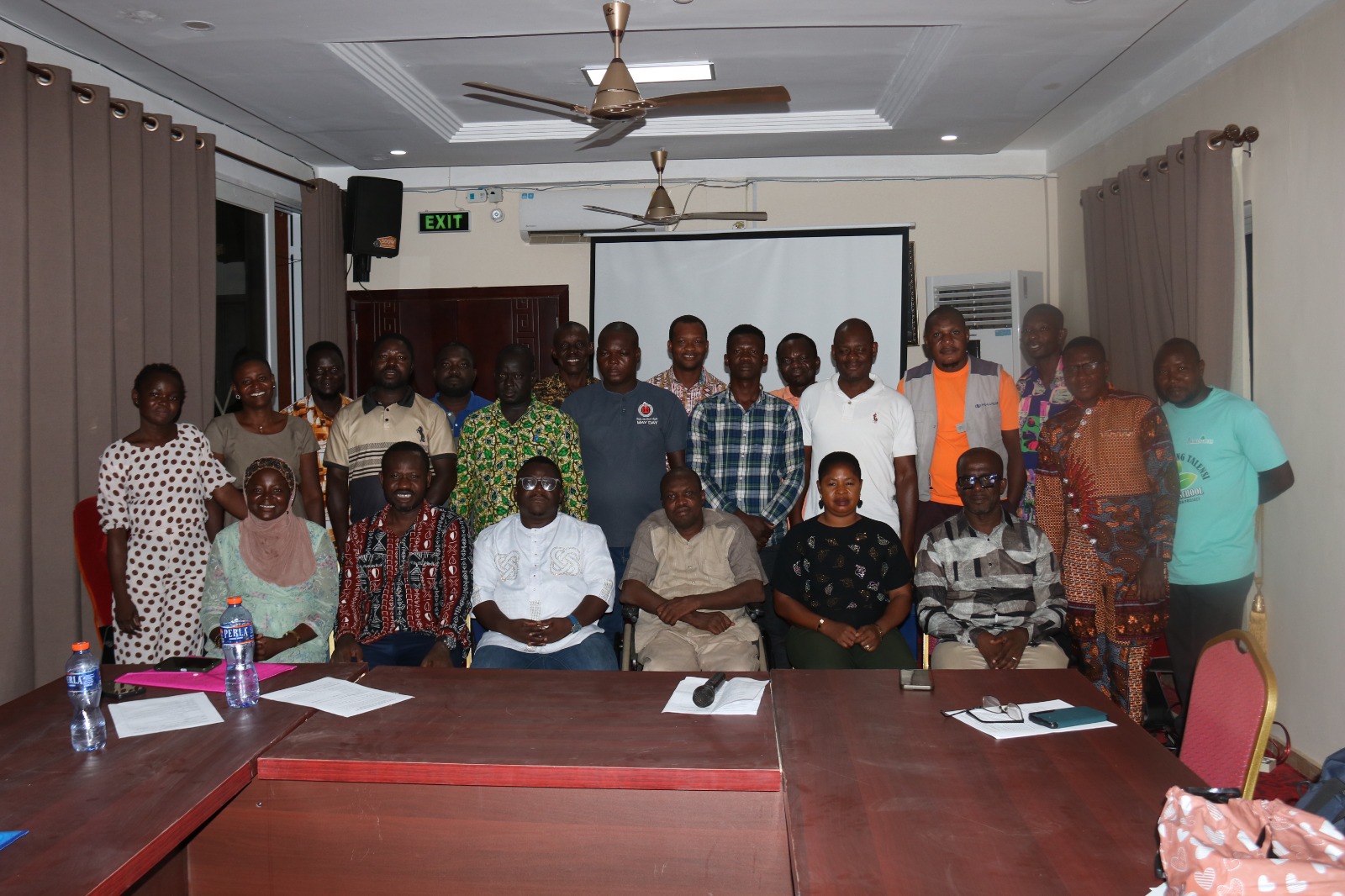
UE/R: SOCO PROJECT FACILITATORS URGED TO WORK HARD FOR THE SUCCESS OF THE PROJECT – DCE NABDAM

BY: ATUIMAH VALERIUS
Officials from the Ministry of Food and Agriculture (MOFA) introduced the “Feed Ghana Program” during an in-studio discussion at GBC Ura radio Bolgatanga, as a flagship agricultural program of President Mahama. The in-studio session, hosted by Florence Ayamga, featured Alhaji Zakaria Fuseini, Regional Director of Agriculture (Upper East Region); Peter Nuhu, Coordinator of Farm Service Centers; and Charles Ayueboro Adama, Deputy Director with the Policy Planning, Monitoring, and Evaluation Directorate, MOFA Headquarters in Accra.
The “Feed Ghana” program aims to revolutionize agricultural production in Ghana, ensuring food security, creating jobs for the youth, reducing imports, expanding exports, and increasing raw material production for value addition. Peter Nuhu explained that the program, launched in April, is structured to roll out various benefits across several areas.
A key requirement for farmers to benefit from the program is membership in a registered farmer group or cooperative. Charles Ayueboro Adama stressed the importance of these groups being community-based and commodity-based, focusing on specific crops or livestock. Targeted commodities include cereals and legumes (maize, rice, soya bean, sorghum), vegetables (tomatoes, onions, pepper), and starchy crops (plantain, yam, cassava).
Peter Nuhu further elaborated that the program extends beyond crops to include livestock, prioritizing poultry, large and small ruminants (goats, sheep, cows), and pigs. He clarified that while these are priority areas, support would generally extend to other animal rearing as well.
Alhaji Zakaria Fuseini outlined the registration process, stating that it occurs at the district level through Agricultural Extension Agents (AEAs). He urged farmers to register promptly as the farming season has commenced, emphasizing that waiting for deadlines is not advisable.
Addressing concerns about existing cooperatives, Charles Ayueboro Adama confirmed that all existing groups must re-register to populate a new, comprehensive farmer database. New groups are required to have between 15 and 40 members, while existing groups exceeding 40 members can register all their members.
A significant component of “Feed Ghana” is the establishment of Farmer Service Centers in every district. Peter Nuhu detailed that these centers will be equipped with machinery, including power tillers and planters, to assist cooperative farmers with plowing, planting, and harvesting. This initiative aims to address challenges such as access to machinery and to combat smuggling, which has historically plagued government agricultural interventions.
Responding to a listener’s query about erratic rainfall patterns and the need for irrigation in the northern regions, Peter Nuhu confirmed that agricultural infrastructure and irrigation are full components of the “Feed Ghana” program. This aspect is designed to support climate adaptation and dry season farming, assuring farmers that their concerns regarding water scarcity have been considered.
The MOFA officials underscored that the cooperative model is crucial for accountability, allowing for better tracing of beneficiaries and ensuring that inputs like fertilizers reach legitimate farmers, thereby curbing fraud and smuggling. Inputs, such as fertilizer amounts, will be agronomically determined by AEAs based on specific crop and land requirements.