UE/R: SOCO PROJECT FACILITATORS URGED TO WORK HARD FOR THE SUCCESS OF THE PROJECT – DCE NABDAM
BY: PROSPER ADANKAI
Youth leaders in Ghana’s Upper East Region are calling for amendments to the National Peace Council Act to formally guarantee youth
representation at the national level, arguing that peacebuilding frameworks must reflect the country’s demographic reality. While young
people are represented on local peace committees, stakeholders say the absence of a clear legal provision at the national level leaves youth
participation discretionary rather than guaranteed by law.
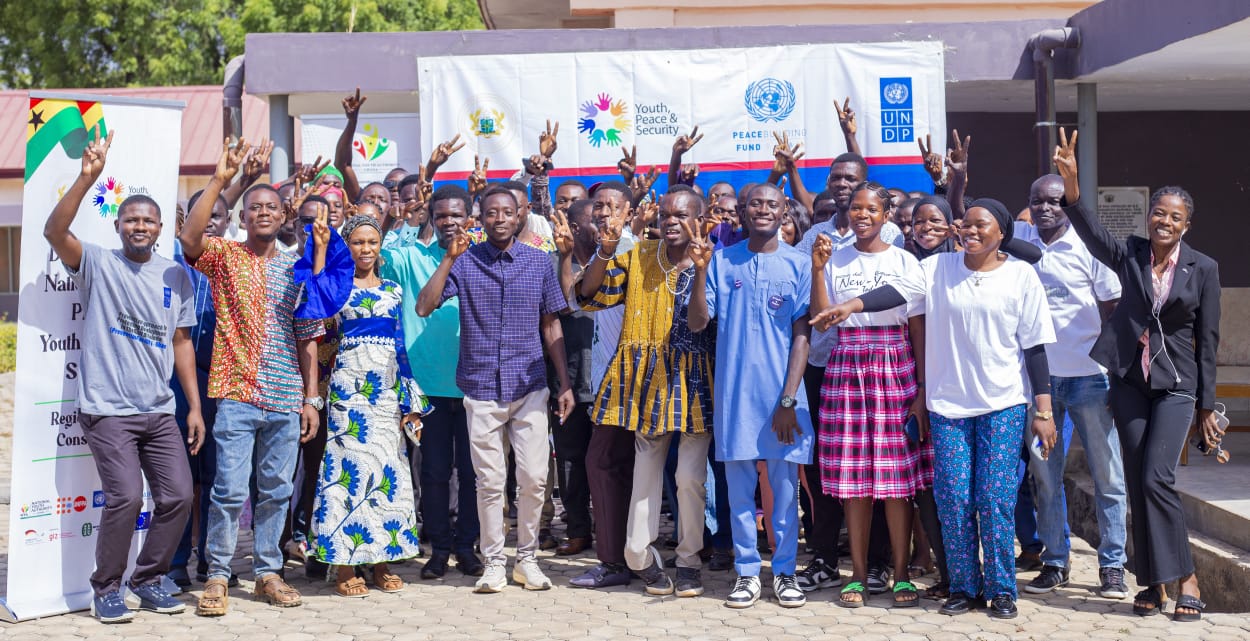
The call emerged during a two-day consultation in Bolgatanga, where youth leaders, community members, security agencies, and civil society
organizations engaged in discussions toward the development of Ghana’s National Action Plan (NAP) on Youth, Peace, and Security. The
consultations provided a platform for young people to share lived experiences of conflict, contribute policy ideas, and push for reforms
that strengthen inclusive peace governance.

Organised by the National Youth Authority (NYA) with support from UNDP, UNFPA, GIZ, the National Peace Council, the National Commission for Civic Education (NCCE), and the Kofi Annan International Peacekeeping Training Centre, the engagement brought together youth leaders on January 26, followed by broader stakeholder participation on January 27, 2026.
Participants stressed that while youth involvement at the community level has proven effective in preventing conflict and promoting dialogue, the lack of a statutory requirement for youth representation on the National Peace Council weakens their influence in shaping
national peace and security policies. They argued that formalising youth representation through legislation would move Ghana beyond
goodwill-based inclusion to institutional accountability.

The consultations were anchored in United Nations Security Council Resolution 2250, which recognizes young people as critical actors in
conflict prevention, peacebuilding, and countering violent extremism. Globally, one in four young people live in or are affected by
conflict, underscoring the urgency of embedding youth voices in peace structures at all levels.
Upper East Regional Director of the National Youth Authority, Francis Takyi-Koranteng, noted that young people have historically been
marginalized or unfairly portrayed as sources of instability. He emphasized that Ghana’s youthful population makes youth inclusion not
optional but essential, adding that the quality of contributions from Upper East participants demonstrated their readiness to shape national
peace frameworks.
UNDP officials observed that the consultations created structured spaces for listening, validation, and co-creation, allowing young
people to move from symbolic participation to meaningful influence. They noted that anchoring youth engagement in law, rather than discretion, would strengthen the legitimacy and sustainability of Ghana’s peace architecture.
The Upper East engagement forms part of a nationwide consultation process aimed at developing an inclusive National Action Plan that
harnesses youth energy, creativity, and leadership for peaceful and inclusive development. Stakeholders agreed that formal legal
recognition of youth in national peace institutions would reinforce trust, accountability, and long-term stability.
As Ghana advances its Youth, Peace, and Security agenda, the Upper East consultations are reinforcing a growing consensus: young people
are not merely beneficiaries of peace—they are central actors whose voices must be protected by law. The push to amend the National Peace
Council Act reflects a broader shift toward embedding youth leadership at the heart of national peace building efforts.